
The Future of Rural Healthcare Depends on a New Operating Model
For years, we've treated rural healthcare as a funding problem. It's actually an operating model problem.
Across the country, rural health systems are being asked to improve quality, reduce costs, manage population health, and succeed in value-based care. While facing workforce shortages, shrinking margins, and aging populations. The expectations now mirror those of the largest health systems.
Until we normalize how rural healthcare operates, we'll continue asking rural providers to achieve value-based outcomes using systems designed for episodic care.
The Real Challenge: Capability, Not Just Cost
Most conversations about rural healthcare focus on reimbursement reform, hospital closures, and financial sustainability.
Those conversations matter. But they often overlook the underlying issue.
Population health doesn't happen because organizations receive more funding. It happens because they have the operational capabilities to identify risk early, coordinate care across settings, engage patients between visits, and continuously measure performance.
Too many rural organizations are expected to deliver these outcomes without access to:
- Connected, longitudinal patient data across clinical and claims sources
- Coordinated workflows across care teams and partners
- AI-driven prioritization and decision support
- Community resource integration
- Scalable patient engagement
Without these capabilities, care becomes reactive rather than proactive.
Patients are identified too late. Care gaps remain open too long.
Providers spend valuable time searching for information instead of caring for patients.
Costs continue to rise as preventable conditions become increasingly complex.
What the Future Actually Requires
To thrive in value-based care, rural healthcare organizations need a new set of foundational capabilities.
They need the ability to:
- Identify rising-risk patients before conditions worsen
- Access complete, longitudinal patient records regardless of where care was delivered
- Coordinate care across hospitals, primary care, specialists, behavioral health, pharmacies, laboratories, and community organizations
- Engage patients beyond traditional office visits through accessible digital experiences
- Measure and improve quality, risk adjustment, utilization, and financial performance across contracts
- Leverage AI to augment limited clinical resources and prioritize interventions
From Fragmentation to Connected Rural Care Ecosystems
The future of rural healthcare will not be built through more point solutions.
It will be built through connected ecosystems.
Population health is no longer owned by a single organization. It is the coordinated work of providers, hospitals, payers, public health, and community partners operating from the same data foundation.
That is the idea behind Rural Population Health Management (RPHM).
Rather than treating each organization as an isolated participant, RPHM creates an operating model that connects people, data, workflows, and intelligence across the entire rural healthcare ecosystem.
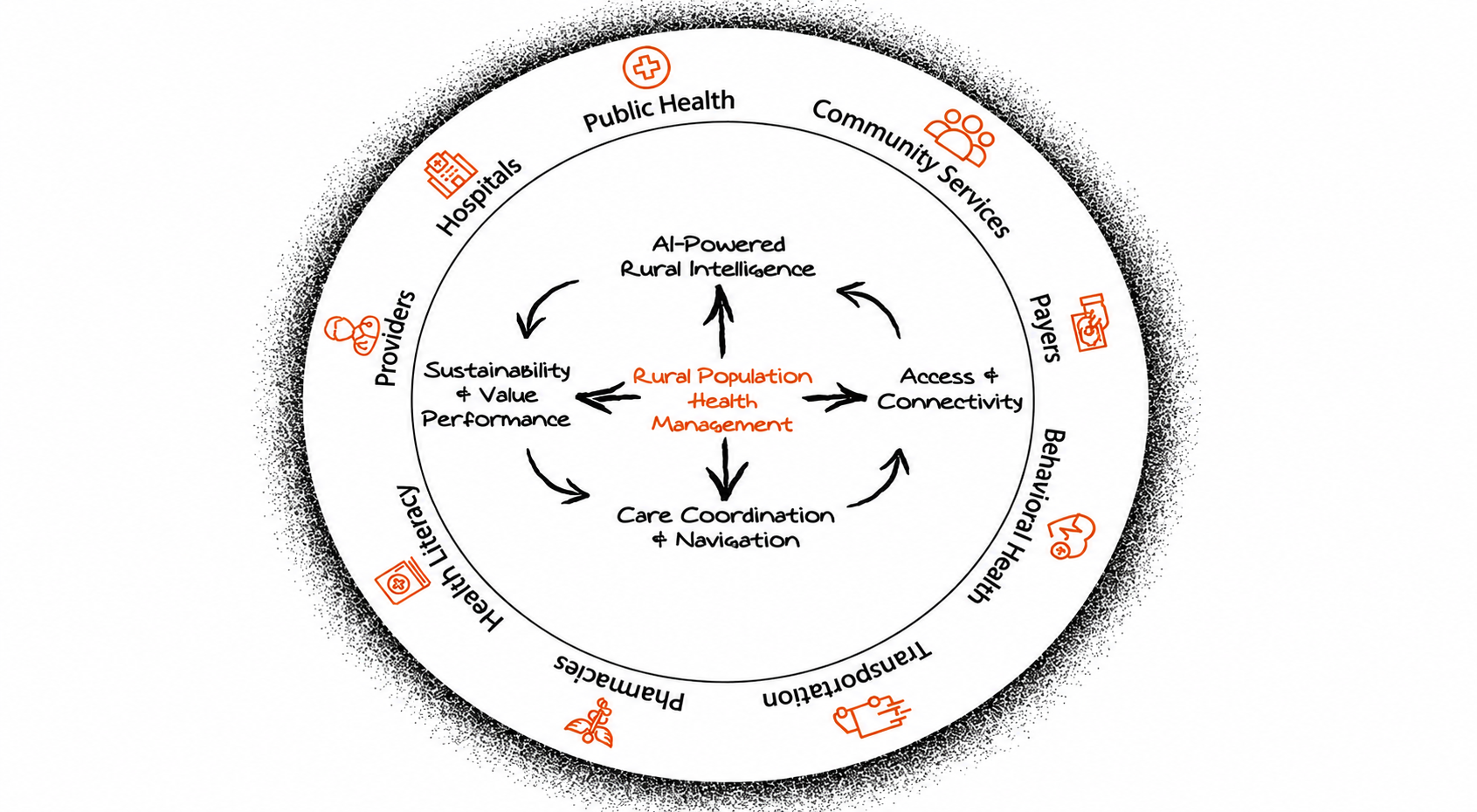
Rural Population Health Management Ecosystem
At the center is Rural Population Health Management, powered by four interconnected capabilities:
- AI-Powered Rural Intelligence Improving Outcomes at Scale
- Care Coordination & Navigation Lowering Total Cost of Care
- Access & Connectivity
- Sustainability & Value Performance
Surrounding this foundation is the broader rural healthcare ecosystem, connecting providers, hospitals, public health, behavioral health, community services, transportation, pharmacies, health literacy resources, and payers through a common layer of interoperable data and coordinated workflows.
Because hospitals cannot reduce readmissions without visibility into primary care - Primary care cannot effectively manage chronic disease without behavioral health and community support - Behavioral health cannot intervene early without access to longitudinal patient information - Public health cannot improve community outcomes without connected data across the entire ecosystem.
Population health succeeds when the ecosystem works together.
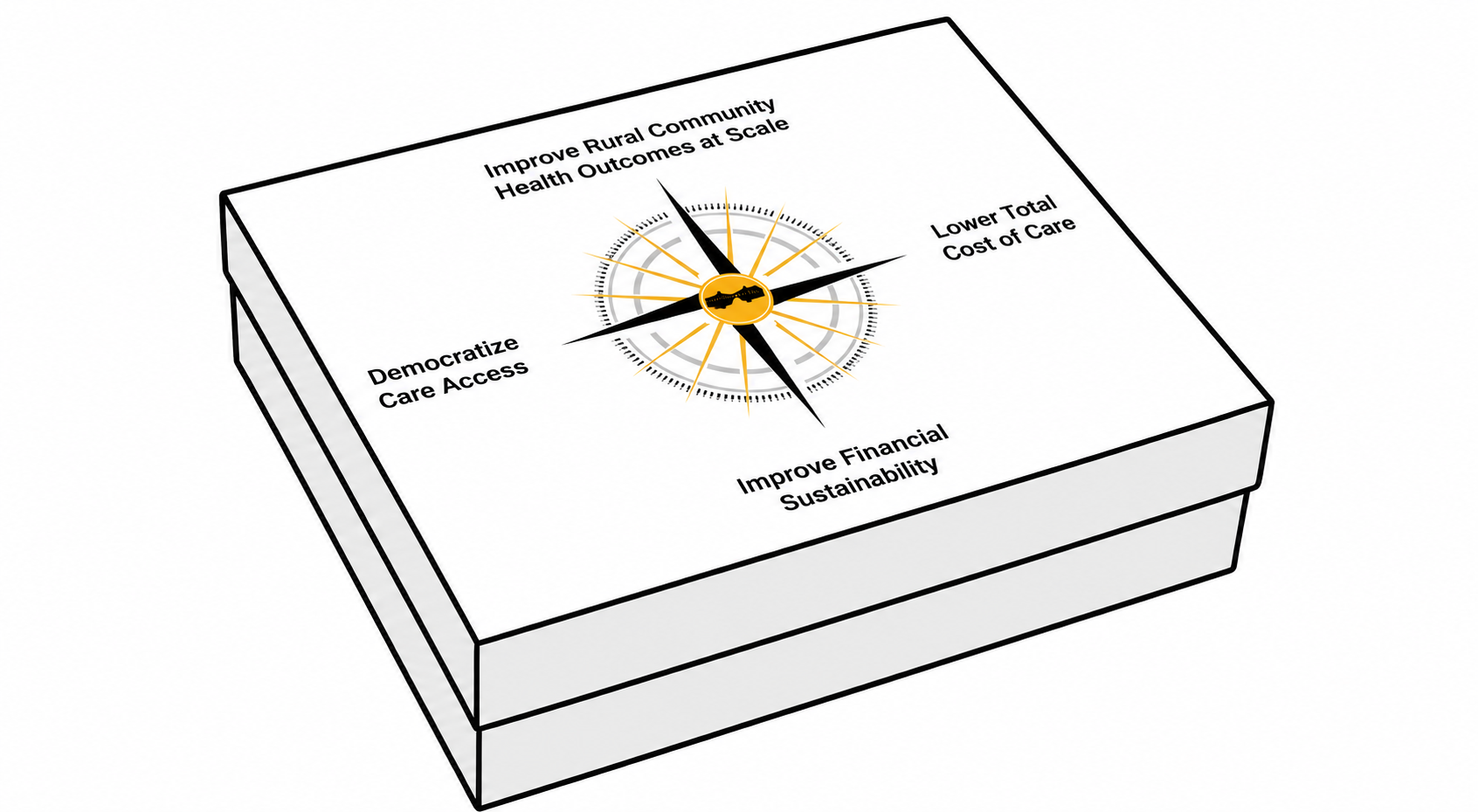
Introducing Rural Population Health Management "In a Box"
Imagine if a rural health system could launch a comprehensive population health program without spending years integrating multiple vendors, building custom interfaces, hiring additional analysts, or redesigning every workflow from scratch.
That's the idea behind Rural Population Health Management (RPHM) in a Box.
A ready-to-deploy operating model that is pre-integrated, interoperable, and designed to run across rural ecosystems without years of build-out.
Instead of assembling disconnected technologies, RPHM in a Box brings together the capabilities rural organizations need to succeed while working together on a single foundation.
AI-Powered Rural Population Intelligence
Unified clinical, claims, and SDOH data create a longitudinal view of each patient and population. AI continuously identifies emerging risk, prioritizes interventions, and surfaces actionable insights to drive earlier, more targeted care.
Access & Connectivity
Interoperable data exchange and connected infrastructure ensure timely access to complete patient information across settings. This enables seamless coordination between providers, payers, and community partners while expanding access to care across rural populations.
Care Coordination & Management
Integrated workflows and intelligent prioritization align care teams across the continuum. Care managers can focus on the highest-impact patients, coordinate interventions, and navigate individuals through the system more efficiently despite limited resources.
Sustainability & Value Performance
Performance analytics and contract optimization capabilities align clinical activity with financial outcomes. Organizations can improve quality scores, risk adjustment accuracy, utilization, and total cost of care while strengthening long-term financial sustainability in AN value-based models.
These capabilities aren't separate applications. They're components of a single operating system designed to work together for the realities of rural healthcare.
When implemented, this model shortens time to value, reduces operational burden, and drives measurable improvement in quality, access, and total cost of care.
Why Interoperability Changes Everything
Fragmented information remains one of the greatest barriers to rural healthcare transformation.
When patient data exists in disconnected systems, organizations face duplicated testing, delayed treatment, fragmented care plans, avoidable admissions, and missed opportunities for early intervention.
Interoperability isn't simply an IT initiative. It's the foundation of modern care delivery.
With frameworks like TEFCA expanding nationwide trusted exchange, organizations can increasingly access more complete longitudinal patient records regardless of where care occurred.
Connected data enables:
- One patient. One longitudinal record.
- Real-time clinical visibility.
- Coordinated care across every setting.
- Better quality and risk adjustment performance.
- Reduced duplication and unnecessary utilization.
- Earlier interventions that improve outcomes while lowering costs.
For rural communities where specialty access is limited and patients often travel significant distances for care these capabilities become even more important.
Interoperability isn't simply an IT initiative. It is the foundation of modern rural healthcare delivery.
When the Operating Model Works, Everything Moves Together
Over the past 14 years, we've seen a consistent pattern across more than 180 healthcare organizations, supporting 16 million lives, 26,000 clinicians. The organizations creating lasting transformation aren't simply deploying new technology. They're redesigning how care operates. When the operating model is connected, outcomes that once appeared to compete with one another begin moving in the same direction. Communities become healthier, access expands, quality improves, total cost of care declines, financial sustainability strengthens.
A Better Path Forward
One that gives every rural organization access to the intelligence, coordination, interoperability, and population health capabilities that have historically only been available to the nation's largest health systems.
Because geography should never determine the quality of healthcare.
Let's Build the Future of Rural Healthcare Together
Every rural community is different. Every health system has its own challenges, priorities, and resources. But the goal is shared: better care, stronger outcomes, and a more sustainable future for the communities they serve.
If you're focused on strengthening population health strategy, modernizing care coordination, improving interoperability, or accelerating value-based care, we'd welcome a conversation.
Whether you're early in your transformation or looking to accelerate existing initiatives, we'd love to connect and share what's working in the field.
Connect with our team to schedule a conversation or request a demo of our Rural Population Health Management framework and the Bridge platform.
Email : info@thegaragein.com


- I'm curious. I'd like
to set up a demo - What does the
platform do? - Tell me more about
the Garage - What has been the
platform's impact?
