
The Proof Era
Healthcare Is Being Judged on Operational Reality, Not Narrative
By Stacy Fox, Chief Growth Officer
The platforms winning in value-based care are no longer the ones with the loudest messaging, fastest expansion, or biggest acquisition strategy. They're the ones producing measurable outcomes inside workflows - generating 200,000+ agentic care events every month, producing nearly $1 billion in ACO gross savings, and delivering real-time clinical and contract intelligence at the point of decision-making inside care workflows.
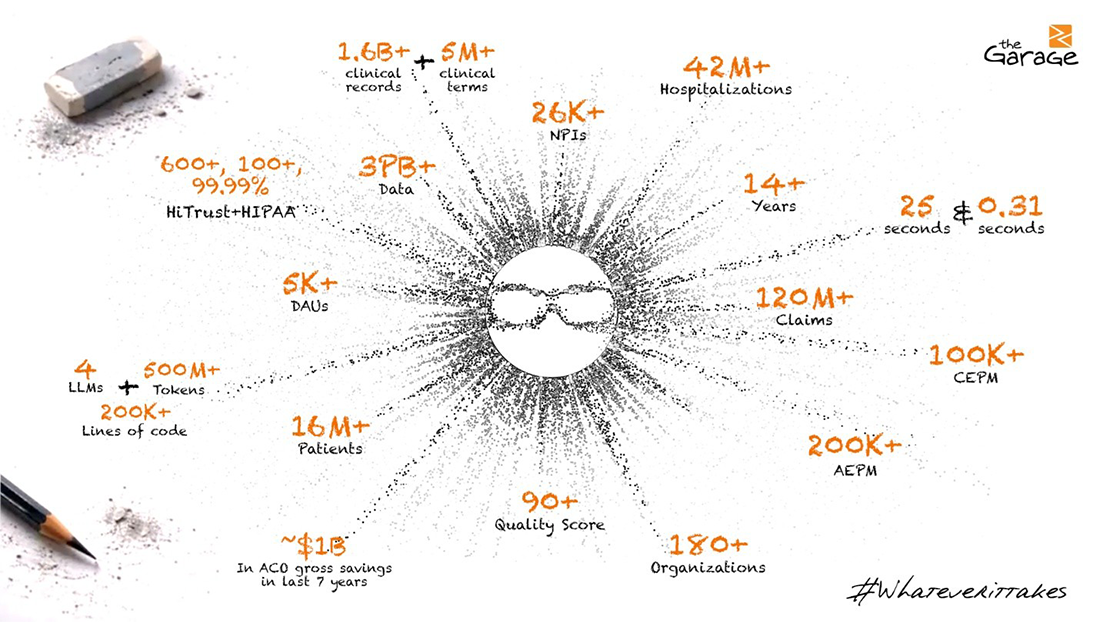
Healthcare has entered a new phase of value-based care maturity
The market now rewards proof:
- Operational proof
- Auditable proof
- Workflow proof.
Healthcare leaders are asking a far harder question than they were even two years ago:
Is this platform improving outcomes inside my organization - or just generating another dashboard?
That shift changes everything.
Care teams are overloaded. Margins are compressed. Risk contracts are expanding. CMS scrutiny and board accountability are rising.
Every platform is now being evaluated against one standard: prove operational impact or become shelfware.
Care teams do not need another dashboard. They need systems that quietly remove friction inside already overwhelmed workflows.
The evaluation criteria have permanently shifted:
- Vision → Validation
- AI narratives → Operational outcomes
- Platform consolidation → Workflow consolidation
- Feature lists → Measurable performance
The question is no longer: "Does your platform have AI?"
The question is: "What measurable outcomes did your AI create last quarter?"
Applied Intelligence Only Works Inside the Workflow
The first generation of healthcare AI lived outside the workflow. Dashboards, copilots, summaries, and disconnected intelligence layers still required clinicians and operators to manually bridge the gap between insight and action.
That model is already hitting its limits.
Applied intelligence only creates value when it changes what happens inside the workflow in real time, at the point of decision-making.
The platforms driving outcomes today are not delivering more insight. They are embedding intelligence directly into existing workflows by triggering actions, routing work, and reducing friction inside the systems care teams already use.
- Not another login.
- Not another dashboard.
- Not another insight delivered after the clinical moment has passed.
In healthcare, adoption does not happen through access. It happens through workflow alignment. Intelligence outside the workflow becomes noise. Intelligence inside the workflow becomes execution.
At The Garage, that operational model shaped Bridge from the beginning. It was built inside the realities of value-based care, where fragmented workflows, delayed interventions, and disconnected data create real operational consequences for care teams and patients. Applied intelligence is not layered on top of the workflow. It is embedded directly into how the workflow operates.
14 Years of Building for Outcomes.
For 14 years, The Garage has built inside the operational reality of value-based care. Inside ACOs, health systems, FQHCs, CINs, IPAs, and payer-provider workflows where complexity is constant and operational performance matters every day.
Today, that operational scale spans 180+ organizations across 48 states, 16M+ patient lives managed, more than 200K monthly agentic care events, and nearly $1 billion in ACO gross savings over the last seven years.
"Blaze Agents gives our team real-time visibility into patient movement and meaningfully reduces the administrative burden on care managers. It's not a separate tool - it's embedded directly in the workflow our team lives in every day."
Darcy Shepard, CEO, Middletown Medical
200,000 Agentic Events a Month. Here's Why That Number Matters.
Most healthcare platforms still measure engagement in clicks, dashboards, or reports viewed. Real operational actions inside the workflow that change what happens next for a patient or care team.
At The Garage, 200,000+ monthly agentic events means admissions routed in real time, care gaps automatically triggered for outreach, quality risks surfaced before deadlines, and contract intelligence delivered at the point of decision. It is not insight sitting outside the workflow. It is execution inside it. This is the operating layer behind Blaze Agents, BlazeSync, and BlazeSpeaks, built to embed intelligence directly into value-based care workflows, not sit on top of them.
Speed Is a Clinical Variable. Treat It That Way.
Speed is one of the most overlooked drivers in population health because it directly shapes clinical behavior, and those behaviors show up in quality, risk capture, and utilization.
When patient context is slow to access, clinicians use it less. When they use it less, documentation and coding suffer. That friction compounds across thousands of users and millions of patients, and it rarely shows up as a system issue. It shows up as underperformance.
At The Garage, speed is treated as infrastructure, not a metric. Contract ingestion and activation happens in ~25 seconds, translating reimbursement and quality logic directly into workflow. Clinical document intelligence operates at ~0.31 seconds at the model level, making longitudinal patient context instantly available at the point of decision.
When systems respond at the speed of care, they get used. When they get used, performance improves.
"The best healthcare infrastructure is infrastructure clinicians stop noticing entirely because it moves at the speed of decision-making and consistently across workflows."
The Question Every Payer and Health System Should Be Asking
Healthcare wants AI that reduces burden, improves care coordination and quality performance, strengthens risk visibility, supports care teams, and drives measurable financial outcomes. It does not need more AI demos. It needs operational intelligence that improves performance inside real workflows every day.
For population health leaders, the question is simple: is your platform producing measurable outcomes or just reporting on them?
CMS does not reward dashboards. Shared savings does not reward positioning. STARS does not improve because systems are well architected. The market rewards execution inside the workflow.
Healthcare's Proof Era Has Arrived.
The Garage network now spans 180+ organizations, 16+ million patient lives, 1.6+billions of clinical records, hundreds of integrations, and nearly $1 billion in ACO savings.
- Not because the narrative was compelling.
- Because the platform works.
- Because it fit the workflow.
- Because it generated outcomes.
Healthcare's next decade will belong to the platforms closest to operational reality.
- The ones embedded into workflows.
- The ones trusted by care teams.
- The ones producing measurable savings, measurable quality improvement, measurable adoption, and measurable clinical impact.
See What Operationalized Intelligence Looks Like Inside Real Healthcare Workflows. Join the 180+ organizations building with The Garage and explore how Bridge is helping payers and health systems operationalize value-based care at scale.


- I'm curious. I'd like
to set up a demo - What does the
platform do? - Tell me more about
the Garage - What has been the
platform's impact?
